Read the Bracket Before You Ready Up
A tournament lobby can look familiar while hiding unfamiliar rules. Imagine your five-player team preparing for an online tactical tournament with eight teams: the lobby shows two groups, a playoff bracket, and a start time of 19:00. That is not enough information…
A tournament lobby can look familiar while hiding unfamiliar rules. Imagine your five-player team preparing for an online tactical tournament with eight teams: the lobby shows two groups, a playoff bracket, and a start time of 19:00. That is not enough information to know what you are entering. Before anyone presses ready, identify the tournament’s basic structure: how many opponents you face, what counts as a match, and which results determine advancement. Those details tell you whether tonight involves one short series or several hours of scheduled play.
First, separate a game from a series. In this example, each group-stage match is a best-of-one, while each semifinal is a best-of-three. A best-of-one ends after a single map produces a winner; a best-of-three usually ends when one team wins two maps. Do not assume that every listed match requires the same commitment. If the lobby displays “BO3,” check whether it applies to your next match or only a later stage. Also confirm whether every game needs a winner or whether the format permits drawn results.
Next, work out how opponents are assigned. Our eight-team tournament divides entrants into two groups of four, with each team playing every other team in its group once. That guarantees three group matches, regardless of whether you win the opener. A single-elimination bracket would create a very different situation: one lost series could end your run immediately. A double-elimination bracket generally allows a team to survive one series loss, but its final-stage rules can vary. Read the actual bracket rather than treating “tournament” as a complete description of the format.
Once you understand the group structure, check precisely how teams advance. Suppose the top two teams from each group reach the semifinals, with three points for a win and none for a loss. Two wins might feel sufficient, but three teams could finish with identical records. Find the published tiebreak sequence before joining: it might use head-to-head results, map difference, round difference, or an additional deciding game. These methods are not interchangeable. A team should know whether a close loss affects its position before assuming that only the win column matters.
Map selection deserves its own check because a series length does not tell you what you will play. In the example tournament, group matches use a veto that removes maps until one remains, while semifinal teams each select a map before a decider is established. Confirm the available map pool, who vetoes first, and how starting sides are chosen. If a lobby participant named 1gom dev asks whether the higher seed chooses the opening map, the answer should come from the event rules, not an assumption based on another tournament’s procedure.
Now translate the format into a realistic attendance window. Three best-of-one group matches do not necessarily happen back to back, and reaching a best-of-three semifinal can substantially extend the evening. Look for fixed start times, rolling starts, breaks between stages, and any stated latest check-in time. Ask whether your next match begins as soon as both teams are available or only at its scheduled slot. This distinction matters when a teammate can stay until 22:00: being free for the opening match is not the same as being available for the event.
Check the exact roster requirements before choosing the lobby you will enter. A five-versus-five event may require five registered starters, allow a named substitute, and prohibit roster changes after the first match. Another event may permit substitutions between maps but not during them. In our example, a sixth player who can cover the semifinal is useful only if the rules allow that player to register and join at the relevant stage. Confirm whether the same roster must complete every group match, rather than discovering the restriction when someone needs to leave.
Resolve tied scores and unfinished games before they become urgent. A map that reaches its normal round limit might enter overtime, end as a draw, or trigger a replay under specific conditions. Each option changes how long a match can last and how its result is recorded. For the example’s best-of-one group stage, determine whether overtime continues until a winner emerges or follows a capped procedure. Also distinguish a tied map from tied group standings: one concerns the result of a game, while the other concerns ranking teams after several matches.
Read how disconnections interact with the match format. If a player drops during the first map of a best-of-three, does the event allow a pause, require play to continue, or permit a restart only before a defined threshold? Check whether a forfeited map also ends the series or simply gives the opponent one map toward victory. These are different consequences. Before entering, identify where the relevant rule appears and who can issue an official ruling. A standard game lobby setting may not reflect the tournament’s full procedure for interruptions.
Look ahead to the transition between stages, especially if seeding changes your next opponent. In our example, the winner of one group faces the runner-up of the other, so qualifying first and qualifying second lead to different semifinal pairings. Confirm whether results carry forward, whether playoff scores reset, and whether the final uses the same series length as the semifinals. If an event instead uses double elimination, check whether the final has a bracket reset or another stated advantage. Do not assume that every visible bracket follows the same finishing rules.
Finally, compare the lobby’s displayed settings with the rules you have just read. Your team should be able to state that it is entering a four-team round-robin group, playing three best-of-one matches, and seeking a top-two finish before best-of-three playoffs. Verify that the lobby shows the correct opponent, stage, map procedure, and roster size. If one detail conflicts, ask the organizer before readying rather than trying to settle it after play begins. The useful outcome of this check is simple: everyone enters knowing what the next result means and what commitment follows it.
Keep exploring
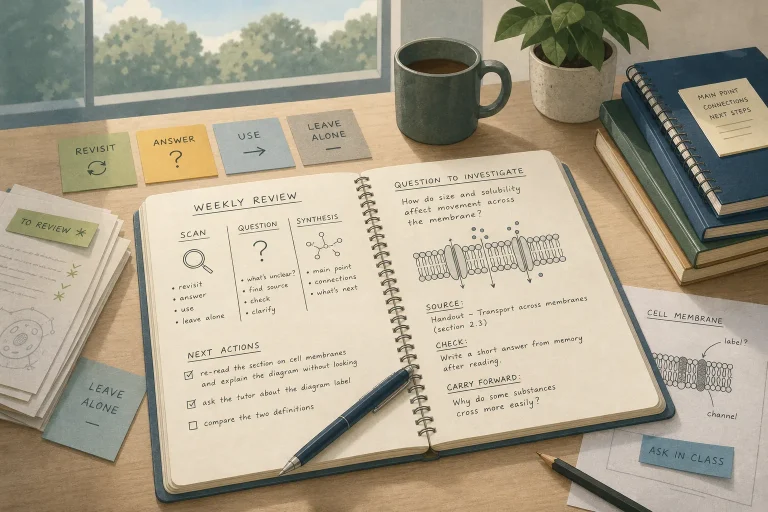
A Weekly Review That Turns Notes into Next Steps
Compare a quick scan, a question-led review and a fuller synthesis to choose a weekly routine…