A Weekly Review That Turns Notes into Next Steps
Compare a quick scan, a question-led review and a fuller synthesis to choose a weekly routine that makes notes useful without turning review into another project.
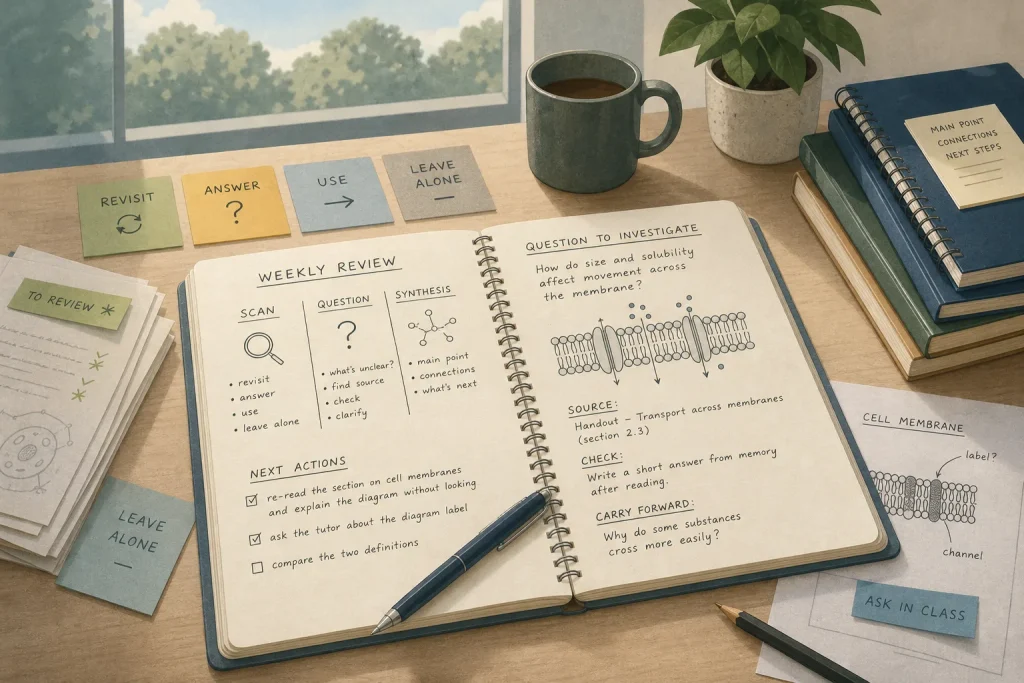
On Friday afternoon, a notebook may contain a lecture sketch, a half-written question about photosynthesis and a page of meeting notes that ends with “look this up.” The pages are not useless; they are simply waiting for a decision. A weekly review can turn that waiting into a short list of things to revisit, without requiring a color-coded system or a free afternoon.
There are three sensible ways to do it: scan and sort, review around questions, or make a brief synthesis. Each suits a different kind of week. The best choice is the one that helps you decide what to do next while leaving enough time to do it.
Choose a scan when the notes are scattered
A scan-and-sort review is the lightest option. Gather the notes you made during the week, whether they are in a paper notebook, a document, a class platform or a voice memo waiting to be transcribed. Look through them once, marking only items that need attention: an unclear term, an unfinished task, a useful idea or a connection worth checking.
Then sort those marks into a few plain categories: revisit, answer, use, and leave alone. “Revisit” means the idea deserves another look. “Answer” means there is a question to resolve. “Use” means the note can support a piece of work or an upcoming conversation. “Leave alone” is a legitimate category, not a confession.
This approach suits people with mixed notes and little appetite for elaborate review. It is especially useful after a busy week, when the immediate task is to regain a sense of what is there. Its weakness is that it can preserve too much. A stack of marked pages is not yet a plan, so finish by selecting a small number of items for the coming week and giving each a visible next action.
Instead of “review chapter notes,” write “re-read the section on cell membranes and explain the diagram without looking.” Instead of “follow up,” name the person or question. A next step should be something you can begin, not a description of a vague future mood.
Choose a question-led review when understanding is incomplete
When your notes come from learning a subject, begin with the questions they leave behind. Read through the week’s material and write down what remains uncertain. Keep questions specific enough to investigate: “How does the cell membrane regulate what enters?” is more useful than “What is biology?”
Sort the questions into three groups: answerable from your notes, answerable with a source or person, and not yet clear enough to pursue. First try the notes. If they do not answer the question, identify a source: a textbook section, a class handout, an instructor’s office hours or a reliable reference. If the question is still foggy, rewrite it in simpler language before spending time searching. Search engines are not known for asking helpful clarifying questions.
This method suits a course, a reading project or any subject where confusion can quietly accumulate. It makes gaps visible and helps choose what to revisit, rather than repeatedly rereading everything. It takes more concentration than a scan, though, and is less useful for notes that are mostly appointments or action items.
For each question you select, write how you will check your understanding. You might answer from memory, sketch a process, explain the idea aloud or compare two examples from your notes. The check should reveal whether you can retrieve or use the idea, not merely recognize the page where it appeared.
Choose a short synthesis when ideas need connecting
A synthesis review asks what the notes amount to as a whole. Read across them and write a brief account of the week’s main ideas, decisions or patterns. Add any link between notes that was not obvious when each was first made, then list the questions or actions that follow.
This suits a project with several moving parts, a reading group or a stretch of study where one idea builds on another. It can prevent useful details from remaining isolated. But synthesis is the easiest approach to overdo. A polished recap may feel satisfying while leaving the actual question unanswered. Keep the summary short and reserve space for what you will do next.
One useful format is: “The main point was…; this connects to…; I still need to find out…; next I will….” The wording is deliberately plain. The review is a working note, not a ceremonial document for future archaeologists.
How to choose and finish the review
Choose the scan when notes are numerous and the main need is triage. Choose the question-led review when you can name specific gaps in understanding. Choose synthesis when the challenge is connecting ideas across several notes. If your week contains all three, combine them lightly: scan first, choose one question to pursue, and write a short synthesis only if a connection matters.
Whichever approach you use, end with a short set of next actions. Each should include a verb and an object: “compare the two definitions,” “ask the tutor about the diagram,” or “draft a paragraph using these notes.” Keep unanswered questions where you will encounter them again, such as at the top of next week’s notebook page or in a single running document. Do not leave them buried in a margin and expect memory to perform filing duties.
Also decide what not to revisit. Some notes are duplicates, temporary reminders or ideas that no longer serve the work. Mark them as done, archive them, or leave them behind. A review is not successful because every note receives equal attention. Its purpose is to make the next useful action easier to see.
Hypothetical worked example: a week of biology notes
Imagine a learner has three pages of biology notes, a handout with a diagram of a cell membrane, and a margin question: “Why do some substances cross more easily?” The learner has limited study time before the next class and does not need a complete rewrite of the week.
They choose the question-led approach. First, they check whether their notes answer the question; they do not. They mark the handout’s section on transport and write a narrower question: “How do size and solubility affect movement across the membrane?” They then select a specific next action: read that section and write a short answer from memory afterward. They also mark one unclear label on the diagram to ask about in class. The expected result is a focused review with one question to investigate and one to carry forward. The tradeoff is that other notes remain unsummarized, which is reasonable because the immediate goal is resolving a particular gap.
Keep the routine modest enough to repeat. A weekly review earns its place when it leaves you with a clear question, a doable action and permission to ignore what does not matter now.
Keep exploring

Set Up a Study Corner in a Shared Room
Create a temporary place to work in a room that serves several purposes, keep supplies contained,…

Practicing a Creative Skill When Time Is Short
A small, repeatable practice session can make room for creative work without pretending the day has…