How to Explain a Difficult Idea in Three Passes
Prepare a clear explanation by moving from plain language to a concrete example, then checking what the learner has understood.
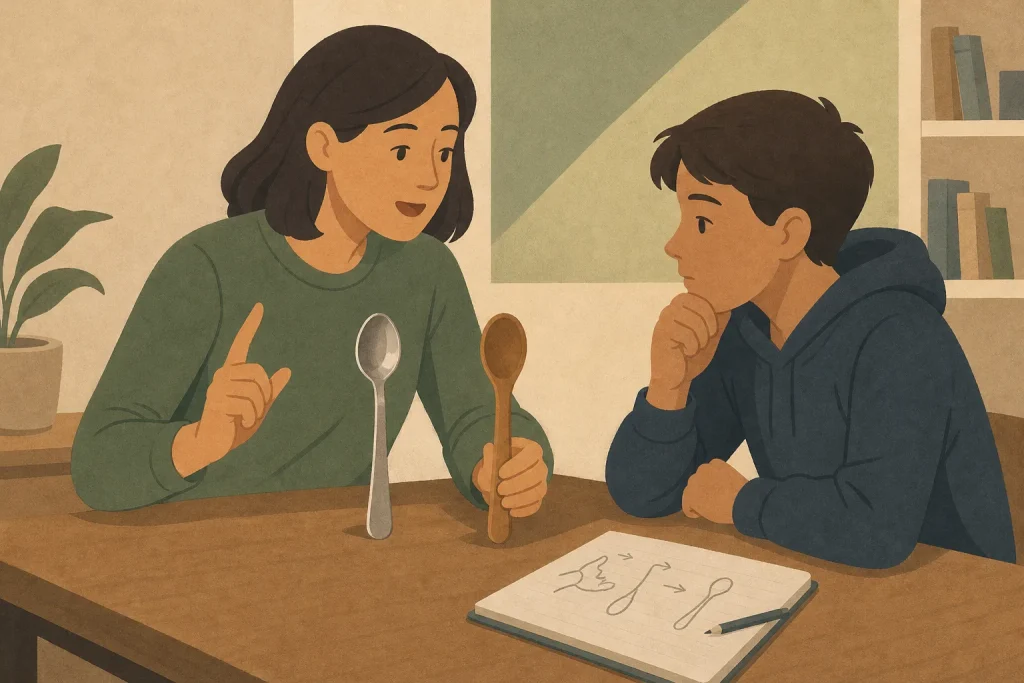
You have two minutes before a class discussion, and someone asks why a metal spoon feels colder than a wooden one in the same room. A quick answer about thermal conductivity may be accurate, but it is unlikely to help if the learner has never met the term. A useful explanation needs a route: begin with the idea in ordinary language, make it visible in an example, then find out what the learner can now explain.
These are three passes over the same idea, not three separate lectures. The first removes avoidable difficulty. The second gives the idea somewhere to land. The third checks whether the learner has a working understanding rather than a sentence they can repeat. Preparing in this order also helps a teacher notice where the explanation is still muddy.
Pass one: say what the idea means
Start by writing a one- or two-sentence version of the idea as if explaining it to a curious person outside the subject. This is not an invitation to make the idea childish or imprecise. It is a test of whether you can identify its central claim before adding terminology, qualifications, or background.
Ask yourself: What is happening? What makes it happen? What should the learner be able to recognize or do afterward? You may not need to answer all three questions in the opening sentence, but knowing the answers keeps the explanation from wandering.
For thermal conductivity, a plain-language starting point might be: “Some materials transfer heat from one place to another more readily than others.” This preserves the important relationship without asking the learner to decode a specialist term first. The word “conductivity” can follow once the idea has a foothold.
Plain language is not simply a ban on technical vocabulary. A precise term can be useful when it names a distinction the learner needs. The sequence matters: give the term a meaning, use it, and return to it later. A word introduced before its job is clear often becomes an extra object to memorize.
There is also a difference between simplifying a sentence and simplifying the idea. “Heat moves” may be an accessible start, but it can conceal what is moving and in which direction. If that distinction matters to the lesson, retain it in ordinary words. Shorter is not automatically clearer; occasionally it is just shorter.
Pass two: make the idea visible in an example
Choose one example that puts the central claim on display. It should be familiar enough that the learner can spend attention on the idea, but not so complicated that several new ideas compete for it. Name the relevant details and connect each one to the explanation. An example is more than a small story placed beside the definition.
For the spoon, the relevant setup is simple: a metal spoon and a wooden spoon have been left in the same room. When touched, the metal spoon may feel colder. That sensation does not, by itself, mean the metal spoon is at a lower temperature. If the spoons are at the same temperature as their surroundings, metal generally transfers heat away from the hand more readily than wood does. The skin can therefore lose heat faster on contact with the metal, which may make it feel colder.
The example helps because it separates the sensation from the temperature of the objects. That distinction is easy to miss when a learner assumes that “feels colder” means “is colder.” A good example makes the likely confusion visible, then gives the learner a reason to revise it.
Choose details deliberately. If you introduce a metal spoon, a wooden spoon, a warm room, a hand, and a thermometer, decide which details do explanatory work. A thermometer might distract if the lesson is about sensation rather than measurement. If you need it, explain its role. Otherwise, leave it out; props do not become clearer by gathering in a crowd.
One example rarely establishes the full reach of an idea. It illustrates a particular case. Say what the case shows and, where necessary, what it does not show. For instance, the spoon example helps explain why materials can feel different to the touch. It does not by itself explain every process involved in heat transfer. This small boundary prevents an illustration from quietly becoming a universal rule.
Pass three: check understanding with a fresh prompt
Now ask the learner to use the idea rather than repeat your wording. A useful check changes one feature of the original example and asks what should happen, or asks the learner to explain why a plausible alternative is mistaken. The prompt should be short enough that the answer reveals understanding instead of testing reading endurance.
For the spoons, you could ask: “If both spoons have been in the room together, why might the metal one feel colder when you touch it?” A learner who says that metal can transfer heat away from the hand more readily is using the explanation. A learner who says only that the metal is colder may still be relying on the original misconception. That answer gives you a specific place to clarify.
A check is not a trap, and silence does not reliably tell you whether the learner is confused. Give the learner time to think. They might answer aloud, sketch a simple diagram, sort examples, or write a sentence. Match the response to the learning task. If the idea is about distinguishing two processes, ask the learner to label or compare them; if it is about explaining a cause, ask for the cause in their own words.
Keep the prompt close enough to the explanation that it checks the intended idea, but vary enough of the example to show whether the learner can carry the idea beyond your exact sentence. If a learner succeeds only when repeating your phrasing, try a different context or ask them to explain the connection. The aim is useful evidence about understanding, not a performance of confidence.
Use the passes to revise, not merely rehearse
The three passes also work as a preparation tool. Draft the plain-language claim, choose a revealing example, then write the check question before you teach. The question often exposes weaknesses in the first two passes. If you cannot imagine a reasonable answer, perhaps the idea is too broad. If the example requires a long chain of extra explanation, it may be poorly chosen.
When the learner’s answer reveals a gap, return to the pass that needs work. If they misunderstand a key term, define it more clearly. If they have the words but cannot apply them, use a second example with a different surface detail. If they understand the example but give a vague answer to the check, ask which part of the explanation supports their claim.
A second example should not merely repeat the first with a new object. It should help separate the main idea from a feature that was incidental. With heat transfer, you might compare how a metal object and a fabric object feel after being in the same room, while keeping the question focused on how readily they transfer heat. The learner can then notice that the material matters more than the object’s name.
Sometimes the check reveals that the learner is ready for a qualification. Add it after the central idea is stable, not as a precautionary pile of caveats at the beginning. A teacher can be accurate without delivering every exception at once. The useful question is whether the qualification changes what the learner should understand or do now.
A hypothetical worked example for explaining fractions
Imagine a teacher preparing a short explanation for a learner who can add whole numbers but treats the denominator in a fraction as if it were another whole number. The teacher has a paper strip, a pencil, and a brief teaching slot. The goal is to explain why one half and two quarters name the same amount, not to teach every fraction operation at once.
Pass one: The teacher writes, “A fraction names a number of equal parts of a whole; the bottom number tells how many equal parts make that whole, and the top number tells how many parts we are counting.” This is plain enough to begin with and preserves the distinction the learner needs.
Pass two: The teacher draws one paper strip, divides it into two equal parts, and shades one. Beside it, the teacher draws an equally long strip, divides it into four equal parts, and shades two. The shaded lengths match. The example makes the relationship visible while keeping the whole the same in both drawings.
Pass three: The teacher asks, “If the same strip were divided into eight equal parts, how many parts would you shade to show the same amount as one half? How do you know?” The learner has to use the pictured relationship rather than simply repeat “one half equals two quarters.” If the learner answers four and points to the matching shaded length, the teacher has a useful sign of understanding. If the learner says eight, the teacher can return to what the denominator counts.
The tradeoff is deliberate: this explanation clarifies equivalent fractions through equal parts of one whole, but it does not cover adding fractions with unlike denominators. Keeping that boundary makes the short lesson teachable. A later lesson can extend the idea once this distinction is secure.
Keep the explanation small enough to carry
Before teaching, place the three passes on a note card or a single slide: the central claim, the example, and the check question. If one pass takes a paragraph to state, decide whether it contains background that belongs elsewhere. If the example depends on a new term, define that term or find a less demanding example.
In the room, leave space for the learner’s response. An explanation is not finished when the speaker reaches the final sentence; it is finished for now when the learner can use the idea in a suitable way, or when the remaining confusion has been identified. A clear first pass, a carefully chosen example, and an honest check give both teacher and learner a better next move.
Keep exploring

Set Up a Study Corner in a Shared Room
Create a temporary place to work in a room that serves several purposes, keep supplies contained,…
Practicing a Creative Skill When Time Is Short
A small, repeatable practice session can make room for creative work without pretending the day has…