Practicing a Creative Skill When Time Is Short
A small, repeatable practice session can make room for creative work without pretending the day has spare hours. Choose one exercise, define its stopping point, and leave a useful note for next time.
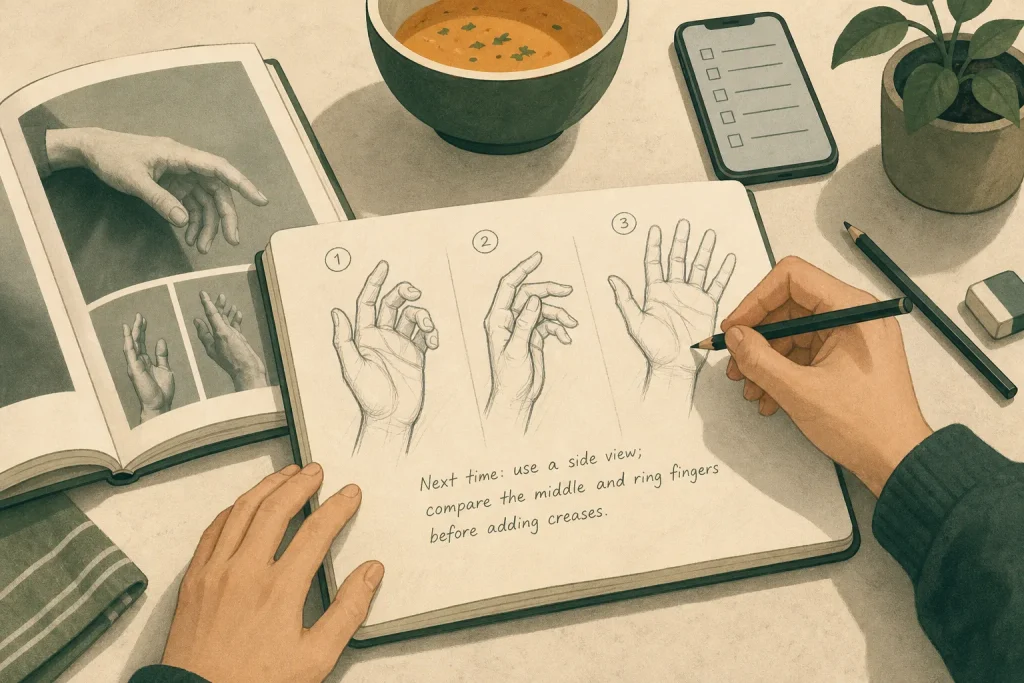
At 8:40 on a Tuesday evening, Mara has a half-finished bowl of soup, a phone full of errands, and a sketchbook she has not opened since the weekend. She wants to improve at drawing hands. The hand in her latest sketch resembles a mitten that has received disappointing news. She has about fifteen quiet minutes before she needs to prepare for the next morning.
In this hypothetical situation, the useful question is not how Mara can fit in a full drawing session. It is what small exercise would give her a clear bit of practice, and how she can stop before the session expands into an argument with the clock. The method below follows her from that choice to a specific note for the next attempt. Its aim is not to make every short session impressive. It is to make one session easy to begin and easy to resume.
Choose one visible part of the skill
“Get better at drawing hands” is a direction, not an exercise. It contains several different problems: proportion, gesture, joints, foreshortening, shading, and the awkward business of deciding where a thumb belongs. Trying to address all of them in a short sitting would make the session broad and difficult to judge.
Mara looks at her last sketch and notices that the fingers are all nearly the same length. She chooses one narrow target: compare the lengths and angles of the fingers in a relaxed hand. That choice is small enough to draw attention to, but meaningful enough to inform a future sketch.
A useful exercise usually has three parts: an action, a focus, and something visible to inspect. “Draw three hand gestures, watching the finger angles” is more workable than “practice anatomy.” The action says what to do; the focus limits what to watch for; the drawings give her something to look at afterward. The exercise need not produce a polished image. In fact, polish would compete with the chosen task.
The same structure transfers to other creative skills. A writer might revise one paragraph for clearer verbs. A musician might play a short passage while listening for an even rhythm. A potter working with air-dry clay might make several small coils and attend to their joins. Each exercise isolates a manageable feature without pretending that the feature is the whole craft.
Set a stopping point before beginning
Mara has around fifteen minutes available, but she does not promise herself fifteen minutes of drawing. She allows a little time to choose a reference, draw, and leave a note. Her stopping point is three quick studies or the end of the short session, whichever comes first. She will not add another study just because the first one looks poor.
This boundary serves two purposes. It protects the rest of the evening, and it prevents the exercise from acquiring extra jobs. Mara is not also going to shade the drawings, clean up the sketchbook, watch a tutorial, or decide whether she should buy a new pencil. Those activities may have their place, but they are not part of tonight’s practice.
A stopping point can be based on a small count, a single passage, or a clear end state. Someone writing might stop after revising one paragraph. A guitarist might stop after playing a chosen phrase slowly and once at a more natural pace. The measure should be simple enough to remember without checking a complicated timer or making a chart. If the available time is unpredictable, a count of attempts can be more useful than a promise to work until a particular minute.
It also helps to decide in advance what happens when attention runs out. Mara can stop after one study if she becomes too tired to look carefully. That is not a failed session; it is a boundary doing its job. The point is to make a deliberate attempt, not to extract the maximum possible number of minutes from an already crowded evening.
Make the first mark quickly
Mara opens a hand-reference book she already owns and chooses a relaxed hand view. She places the sketchbook beside it, takes an ordinary pencil, and draws a loose outline. She is not looking for a perfect reference. She wants one that makes the finger angles visible.
For the first study, she draws the basic gesture and compares the index finger with the middle finger. In the second, she watches how the ring finger tilts toward the little finger. The third is a quick redraw of the whole hand, with the same attention to relative lengths. She does not copy every crease. That restraint is the exercise, not a concession to a lack of talent.
A short practice session can lose its usefulness in preparation. It is easy to spend the available time arranging supplies, choosing among too many tutorials, and deciding which exercise would be best in theory. A familiar pencil and a single reference are usually enough for the first attempt. If a tool is essential to the chosen skill, set it out beforehand when convenient. Otherwise, begin with what is already available.
Mara’s drawings are uneven. That is useful information in a limited sense: the middle finger still looks too short, and the little finger sits too upright. She does not infer anything sweeping about her ability from three sketches. She has found a specific thing to watch next time, which is a better return than an evening spent judging the whole project.
Record the next attempt while the work is in view
Before closing the sketchbook, Mara writes a brief note below the studies: “Next time: use a side view; compare the middle and ring fingers before adding creases.” The note names a next action and a reason. It does not ask her to remember a vague intention such as “draw hands more.”
Useful notes are short because they serve a narrow purpose: helping the next session begin. They can record the exercise, what was difficult to see, and one adjustment to try. A note might read, “Played the opening phrase slowly; the change between chords makes the beat rush; next time tap the pulse while playing.” Or: “Revised the paragraph for verbs; the last sentence still wanders; next time split it before trimming.”
It is tempting to record every observation. Mara could list each line she liked, each one she disliked, and a fresh set of anatomical topics to investigate. That would turn a brief creative practice into a clerical afterparty. She writes only the most useful next move. If she needs a reminder of what she drew, the page itself already supplies it.
Her note also avoids turning one attempt into a verdict. “My hands are bad” gives her no direction except to feel bad about hands. “Check the middle-to-ring-finger length from a side view” points to a drawable decision. Creative work benefits from attention, but attention is more useful when it has a specific object.
Hypothetical worked example: Mara’s fifteen-minute drawing session
Starting situation: Mara wants to practice drawing hands, has a sketchbook, a pencil, and a reference book, and can spare a short stretch of time on a busy evening. The unfinished soup and next morning’s errands are real constraints in this invented scenario; there is no open-ended studio session waiting behind them.
Chosen exercise: Draw three loose studies of one relaxed hand. In each, pay attention to relative finger lengths and angles, leaving out detailed shading and creases.
Stopping point: Stop after the third study or when the available quiet time ends, whichever comes first. Do not add a tutorial, a finished illustration, or a new supply search.
Action taken: Mara selects one clear reference, makes the three drawings, and compares them with the reference. She notices that the middle finger appears too short and the little finger too upright. She writes a note to use a side view next time and compare the middle and ring fingers before adding detail.
Expected result and tradeoff: Mara ends with three imperfect studies and one concrete next action, not a polished drawing. The session does not cover every part of drawing hands; it trades breadth and finish for a focused attempt that should be easy to resume. This is a proposed outcome for the hypothetical situation, not a reported test or proof that the method works for everyone.
Keep the routine flexible enough to repeat
A repeatable practice habit does not require every session to look alike. Mara’s next attempt can use a side view, but if she has less time, she can make one study and write one line. If she has no reference book nearby, she can draw her own hand in a comfortable pose, provided the pose makes the chosen feature visible. The stable part is the pattern: pick one small exercise, set an endpoint, and leave a note for the next attempt.
There are evenings when even a brief exercise will not fit. Mara does not need to manufacture a practice session out of every spare moment. She can leave the sketchbook closed and return when she has enough attention to make a deliberate attempt. A routine that treats ordinary interruptions as moral failures is not a routine so much as a scolding with stationery.
It is also reasonable to adjust the exercise when it proves too broad or too narrow. If Mara cannot tell whether finger angles are the problem because the whole hand outline is unclear, she can simplify further and draw only the palm and finger directions. If the exercise is easy to complete and yields nothing to inspect, she can add a new constraint next time, such as drawing the hand from a different view. The adjustment should follow what she can actually see on the page, not a general demand to work harder.
Short creative practice works best when it leaves a clean edge. Mara puts the pencil down after the planned studies, keeps the note beside them, and returns to the evening she already had. Next time, she will not have to solve the entire question of how to draw hands. She only has to find a side view and compare two fingers. That is a small beginning, and small beginnings are less troublesome to schedule than masterpieces.
Keep exploring
Set Up a Study Corner in a Shared Room
Create a temporary place to work in a room that serves several purposes, keep supplies contained,…
A Calm Way to Organize Files for a Class or Project
A simple folder structure and naming convention can make shared course materials easier to find, update…