Set Up a Study Corner in a Shared Room
Create a temporary place to work in a room that serves several purposes, keep supplies contained, and leave the space ready for whoever needs it next.
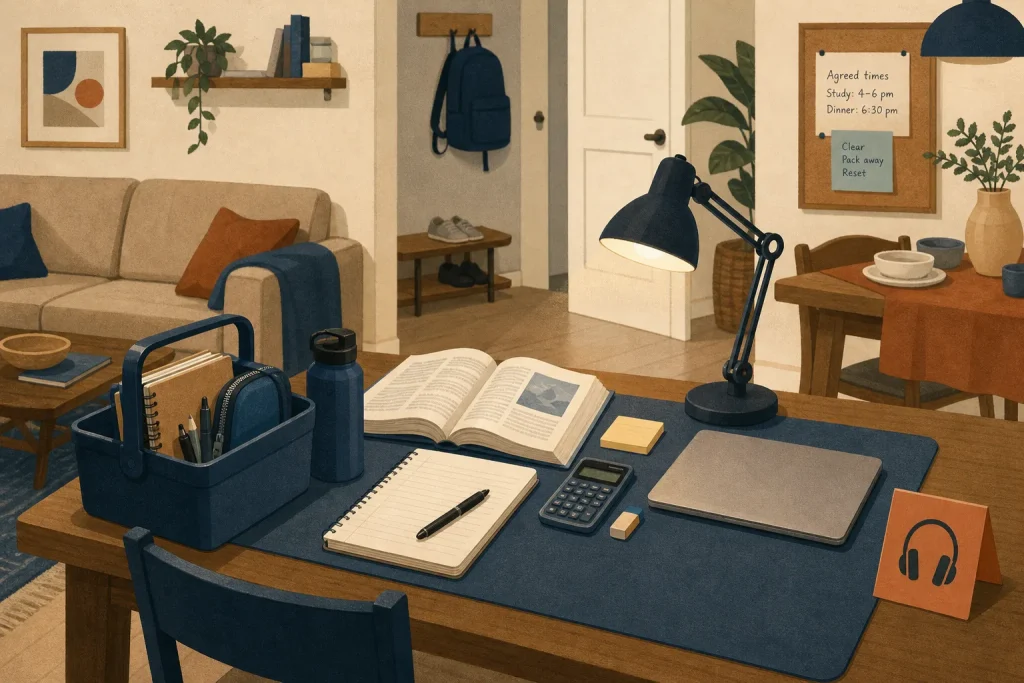
A textbook is open beside the sofa, a charger crosses the path to the door, and someone needs the table for dinner. In a shared room, a study corner cannot depend on owning a corner. It needs a clear boundary, a compact kit and a closing routine that returns the room to its usual job.
The aim is not to make a second desk out of a dining table. It is to make starting predictable and packing away ordinary. Choose a surface that can be used without blocking shared activities, gather only the tools needed for the work, and agree on how the room will be restored. The following sequence works for a kitchen table, a bedroom shared with a sibling, or a living room that changes purpose by the hour.
Choose a place that can change back
Begin by watching how the room is used, rather than picking the spot that looks most like a study area. A dining table may be available in the afternoon but needed for meals. A desk in a shared bedroom may be quiet but occupy someone else’s workspace. A low coffee table may look convenient until notebooks have to balance on a cushion.
Identify a surface with enough room for the materials you actually use, plus a place to set a drink safely. Consider nearby movement: chairs being pulled out, a door swinging open, people carrying laundry, or a pet claiming the warmest patch of floor. A location does not need to be silent; it should be possible to use without making everyone else perform an obstacle course.
Check the light and power before settling on the spot. A lamp can improve a dim table, but its cable should not run across a walkway. If the nearest outlet is occupied, charge a laptop before beginning or use a device with enough battery for the intended session. Avoid moving furniture around every time if doing so makes the setup disruptive. A portable lamp or a clip-on book light may be easier to put away.
Now define the study area visibly. A placemat, desk mat, shallow tray or folded piece of fabric can mark the space without claiming the whole table. It also gives loose items a clear boundary. Choose something that can be removed quickly and will not slide under a notebook. In a shared bedroom, a small tray placed on a dresser may work better than setting up on a bed, where posture and materials tend to become a single untidy pile.
Ask the people who share the room what the boundary means. It might mean that notebooks on the mat are in use, but the table remains available around them. It might mean that the space is reserved during an agreed time and cleared afterward. Make the arrangement concrete: where the work happens, what can remain temporarily, and what must be moved for a meal or another activity. “I need the table later” is less useful than naming when later begins.
Set a boundary that makes interruption manageable
In shared spaces, interruptions are part of the layout. Decide in advance how to signal that you are working without treating ordinary household noise as a personal affront. Headphones, a small card, or simply keeping materials within a defined mat can indicate that a task is underway. These signals should be agreed upon, not invented as a silent household law.
Keep the boundary modest. A study sign does not make a common room private, and headphones do not prevent someone from needing the table. For work that requires concentration, choose a time when the room is less busy if that is possible. For reading, reviewing flashcards or completing a routine exercise, a more active part of the day may be workable. Match the task to the conditions instead of demanding that the conditions become ideal.
Also decide what happens when plans collide. If a meal needs the table, put the current page in a folder and pause at a point where restarting is easy. If another person has an urgent need for the room, move the kit to a preselected backup surface, such as a bedroom dresser or a quiet spot in a library. Having a backup does not require duplicating the whole setup. It means knowing where the work can continue and what can be carried there.
Build a kit around the next task
Once the place is chosen, gather supplies in one container. A pencil case inside a document wallet, a handled caddy, or a sturdy shoebox can hold the items that would otherwise migrate across the room. Pick a container that fits its storage spot and can be carried without spilling. The goal is not to keep every possible school supply within arm’s reach. It is to avoid searching through the household for the few tools needed to begin.
Start with a short core set: the book or printed pages for the current task, a notebook, two or three writing tools, an eraser, and any calculator or ruler the work requires. Add a charger, headphones or sticky notes only if they serve the task. Put small items in a pouch rather than loose at the bottom of a box. Keep water in a stable bottle, away from electronics and papers. If the container becomes a general drawer for unrelated objects, remove them; a kit is more useful when it can be inspected at a glance.
Separate ongoing work from supplies. A folder or elastic document wallet can hold current handouts, marked pages and a brief note about what to do next. Keep completed papers elsewhere so the working folder does not become a historical archive. For digital work, use one device and identify the needed file before sitting down. A charging cable, headphones and a power adapter belong in the kit only if they are not reliably available where you work.
Think through what must remain private or protected. Keep school papers, personal notes and devices out of reach of younger children or household pets when the session ends. If several people use the same computer, sign out of accounts and close personal documents before leaving. These are ordinary housekeeping habits, not an elaborate security system.
Prepare the surface before opening a screen
When it is time to begin, clear only the area you need. Move shared objects to their usual place rather than pushing them into another person’s space. Put the mat or tray down, take out the task folder and select the tools that match the assignment. Leave the rest in the container. A crowded surface makes it harder to notice what is missing and easier to mistake another person’s mail for a worksheet.
Set the chair and materials so that the work can continue comfortably. Use a proper chair where possible; if the available seat is a dining chair, adjust the distance to the table rather than leaning over the page. Position a screen to reduce glare from windows or lamps. Place frequently used items within reach, but keep the center of the surface available for the book, paper or device. These are general comfort suggestions, not a substitute for individualized advice: if a disability, pain or other health concern affects seating or screen use, seek guidance from a qualified professional and adapt the setup to your needs.
If the room is noisy, choose a task that can tolerate interruptions or use headphones at a considerate volume. Write down the immediate next action before getting absorbed in the work. It could be “read the section and mark two questions,” “draft the opening paragraph,” or “solve the assigned problems.” This small instruction helps when someone interrupts or the session ends unexpectedly. Keep it on a sticky note or at the top of the page, not on a loose scrap likely to vanish beneath the sofa.
Keep the first setup deliberately plain. If you discover that you repeatedly need a particular item, add it to the kit after the session. Do not fill the box with theoretical future needs. A spare highlighter that is never used is still a small object, but small objects are remarkably good at forming an unofficial committee.
Work with the room rather than against it
During the session, keep shared rules visible in your choices. If the table is needed soon, avoid spreading materials beyond the marked area. If someone asks to use the room, pause at the next natural stopping point and pack the active papers into the folder. If the work cannot be interrupted, explain how long you expect to need and offer a clear time to clear the space. Be realistic; a deadline is easier to respect when it is not wishful thinking dressed as scheduling.
Use a restart note if the work may span more than one sitting. Record the exact page, problem or file to return to, and the next action. “Continue studying” is not a restart note. “Open the history document, finish the section on trade routes, then check the map question” is. Put the note with the relevant materials so it travels with them.
For online lessons or group calls, check the background and sound before joining. Move sensitive household papers out of view, use headphones if available, and let other people know whether conversation in the room will be audible. If a call requires privacy the room cannot provide, find another location rather than expecting everyone else to become silent furniture.
Close the session in a consistent order
When you stop, save digital work first. Confirm that the file is in the intended folder, close private tabs or accounts, and disconnect any device that should not be left on the shared surface. Put loose worksheets into the active folder, with the restart note on top. Return pencils, calculator and other reusable items to their assigned places in the kit.
Then restore the room. Remove the mat or tray, wipe away crumbs or pencil marks, return chairs and shared objects, and check the floor for dropped items. Coil the charger and place it in the container rather than leaving a cable as a trip hazard. Put the kit in its designated storage spot, such as a shelf, closet or under-bed bin that does not block access to someone else’s belongings.
Finish by checking the table from the point of view of the next person who needs it. Is there a mug to move, a lamp to unplug, or a worksheet that should not remain in public view? The room is ready when another person can use it without having to ask what can be shifted. If the same part of cleanup causes friction each time, change the storage arrangement or the household agreement rather than relying on better intentions.
Hypothetical worked example: a dining table shared with family
Imagine a student who has no private desk. The dining table is available after lunch, but the family uses it for dinner. The student needs a textbook, lined paper, a pencil, a calculator and a laptop for an assignment. The starting constraint is simple: all materials must be packed away when the table is needed, and the route between the kitchen and the doorway must stay clear. These details are invented for illustration.
The student chooses one end of the table and marks it with a thin desk mat. A document wallet holds the assignment sheet and a restart note; a pencil case holds the pencil and eraser; a shoebox under a nearby shelf holds the calculator, headphones and charger. Before starting, the student checks the laptop battery, clears the end of the table and places only the current book and paper on the mat. The family agrees that the mat marks active work, but the table remains shared and must be cleared before dinner.
When a family member needs the table earlier than expected, the student saves the file, writes “finish the map question” on the restart note, returns the papers to the wallet and carries the kit to a bedroom dresser. The resulting decision is to continue only if the dresser has enough room for the book and paper without blocking someone else’s belongings; otherwise, the student pauses and resumes later. The tradeoff is clear: the dresser is less spacious than the table and may suit reading or a short continuation, but not spreading out every assignment material. The arrangement makes the interruption manageable; it does not make the room private or create extra space.
A study corner in a shared room is a small agreement made physical: one surface, one portable kit and one reliable way to put things back. Keep the boundary easy to understand and the container easy to carry. When the setup takes little effort to begin and leaves little behind, study can fit into a shared room without quietly taking it over.
Keep exploring
Practicing a Creative Skill When Time Is Short
A small, repeatable practice session can make room for creative work without pretending the day has…
A Calm Way to Organize Files for a Class or Project
A simple folder structure and naming convention can make shared course materials easier to find, update…